The Walls of Dublin (map)
Leonard R. Strangways' 1904 map of the walls of medieval Dublin, compiled from all available sources, with a short history of the city's walls and gates.
Word count
327 words
Leonard R. Strangways’ 1904 map of the walls of medieval Dublin, compiled from all available sources, with a short history of the city’s walls and gates.
The map
The map reproduced here was compiled by Leonard R. Strangways, whose letters M.R.I.A. show that he was a member of the Royal Irish Academy, and was issued in 1904. As its title says, it was drawn up “from all available sources”: most of the walls had disappeared long before, so their course had to be reconstructed from older maps, documents and the fragments that survived.
The walls of medieval Dublin
Dublin was first fortified by its Norse settlers, whose earthen banks and timber defences were in time replaced by stone. Most of the stone circuit was built under the Anglo-Normans in the late twelfth and thirteenth centuries, funded by grants of murage, a toll levied for building and repairing town walls. The walled city occupied the ridge on the south bank of the Liffey, from around Christ Church Cathedral east to Dublin Castle, which formed the south-eastern corner of the defences. As land was reclaimed from the river, the line was extended northwards towards the quays.
Entry was through a series of gates, among them Newgate, Dame’s Gate, St Audoen’s Gate and the Bridge Gate. As the city spread in the seventeenth and eighteenth centuries the walls lost their purpose, and the gates were demolished one by one. Short stretches survive: the best known is St Audoen’s Arch, off Cook Street, and further remains can be seen at Wood Quay, within the Civic Offices, and at the base of Isolde’s Tower near Essex Street West.
For more, see Harris on the ancient walls, castles and towers of Dublin, M’Cready’s gates of the city explained and dated, and Gilbert’s chapter on Old Bridge, Bridge Street and Gormond’s Gate.
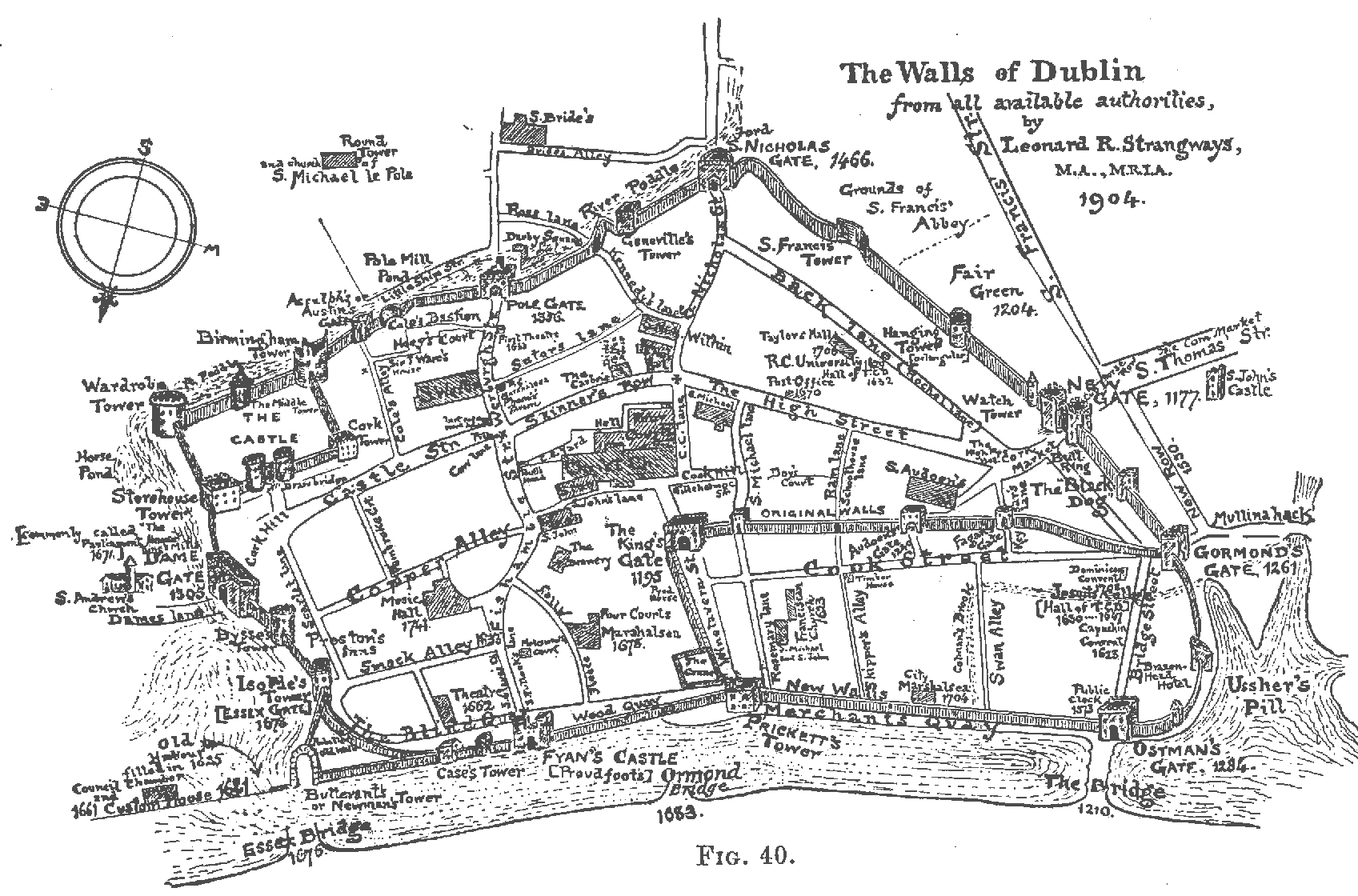
The Walls of Dublin from all available sources. By Leonard R. Strangways, M.A., M.R.I.A., 1904.