Statue of George the Second
The bronze equestrian statue of King George II by John van Nost the younger, erected in St Stephen's Green in 1758 and destroyed by a bomb in 1937.
Word count
415 words
The bronze equestrian statue of King George II by John van Nost the younger, erected in St Stephen’s Green in 1758 and destroyed by a bomb in 1937.
The statue and its sculptor
The statue of George II, who reigned from 1727 to 1760, was the work of John van Nost the younger, a sculptor who worked in Dublin from the mid-eighteenth century and produced several of the city’s public monuments. Cast in bronze, it showed the king on horseback in the dress of a Roman emperor, a common convention for royal statues of the period. The inscription ends with the letters S.P.Q.D., for Senatus Populusque Dublinensis, “the Senate and People of Dublin”, modelled on the S.P.Q.R. of ancient Rome and marking the statue as a civic monument erected by the city. It stood on a tall pedestal at the centre of St Stephen’s Green, then one of the most fashionable promenades in Dublin, which explains the remark below that it looked small in so large a space.
Later history
The Green was laid out anew at the expense of Sir Arthur Guinness, later Lord Ardilaun, and opened to the public in 1880, with the statue still at its centre. After independence, monuments to British monarchs became targets for republicans, and in 1937 the statue of George II was blown up. It was not replaced. The equestrian statue of William III on College Green and Nelson’s Pillar on O’Connell Street were later destroyed in similar ways, the Pillar in 1966.
The description and inscription below come from an older account written while the statue still stood; a few letters of the Latin appear to have been misread in transcription, such as “Ficeli” for Fideli. For more, see the 1892 list of outdoor statues in Dublin, which records the statue and its sculptor, the 1835 account of the statue of King William III, and D. A. Chart’s chapter on Grafton Street, Dawson Street and Stephen’s Green.
Statue of George the Second.
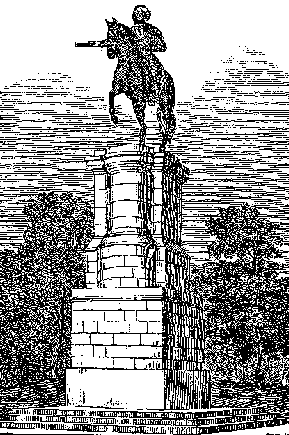 This statue, which stands in Stephen’s Green, possesses
considerable merit; but from the extent of the area in which it is placed, appears
insignificant, and can scarcely be said to be ornamental.
This statue, which stands in Stephen’s Green, possesses
considerable merit; but from the extent of the area in which it is placed, appears
insignificant, and can scarcely be said to be ornamental.
It was erected in the year 1758, and represents the monarch in a Roman habit.
It bears the following inscription
Georgia Secundo
Magnae Brittaniae Franciae
Et Hiberniae
Regit
Forti et Repub1icae
Maxime Ficeli,
Patris Omnibus
Patrem Secut
S. P. Q. D.
A. D. 1758.